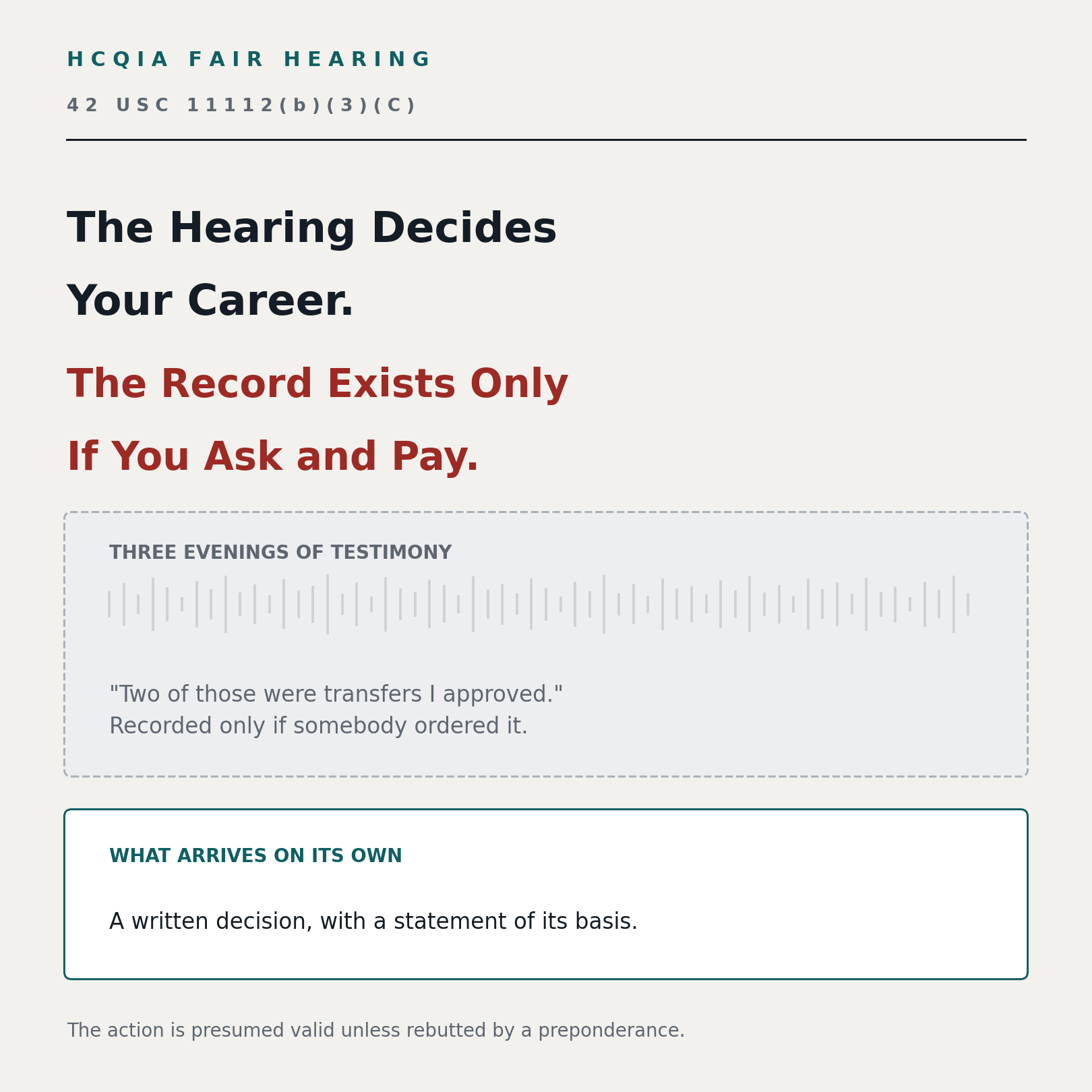
The hearing runs three evenings in the hospital board room. A general surgeon answers questions about eleven cases going back four years, and on the second night the chief of surgery concedes that two were transfers he had personally approved. The room moves on.
Six weeks later the written decision recommends revocation, and the two transfers appear nowhere in it. Whether anyone made a record of that concession depended on whether someone asked for one and agreed to pay for it.
That is not a gap in how one hospital ran one hearing. It is what the statute says.
The Statute Names the Record and Then Makes It Optional
42 USC 11112 is the safe harbor that immunizes a professional review action, provided it was taken after a reasonable effort to obtain the facts of the matter and after adequate notice and hearing procedures.
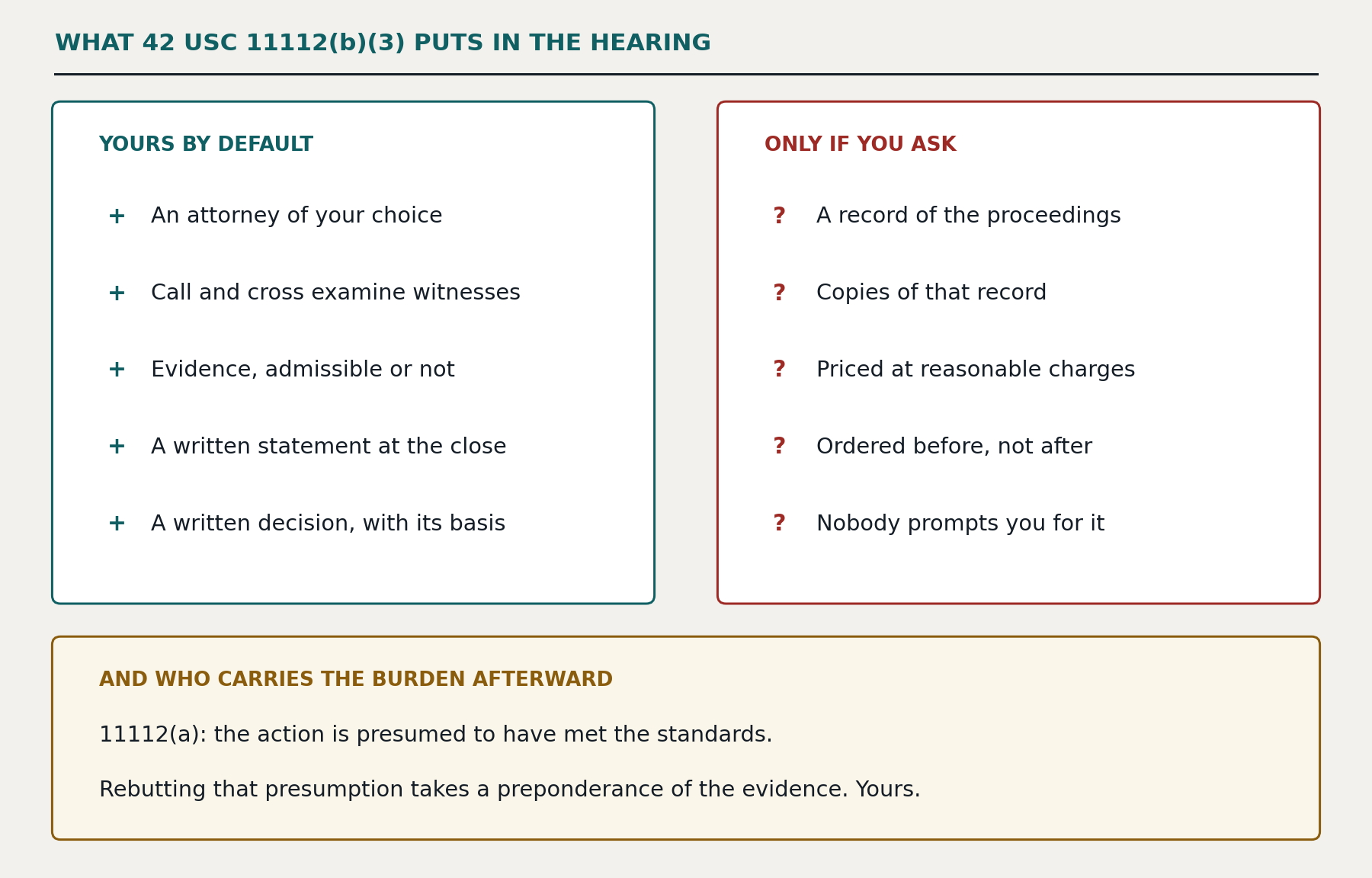
Section 11112(b)(3)(C) lists what the physician gets in that hearing: an attorney, the right to call and cross examine witnesses, and the right to present evidence regardless of its admissibility in a court of law.
Second on that list is the right to have a record made of the proceedings, copies of which may be obtained by the physician upon payment of any reasonable charges associated with the preparation thereof.
Read that clause slowly. The record is a right, not a default. Somebody has to invoke it, and the copy carries a price.
Compare it to the clause directly above it. Nobody has to request the right to counsel; it attaches on its own. The record is drafted differently, and the difference is the entire subject of this article. It is the one item on the list that fails quietly, because the failure looks exactly like a hearing that went smoothly.
Now put it next to 11112(a). A professional review action shall be presumed to have met the standards unless the presumption is rebutted by a preponderance of the evidence. The physician carries that burden, and without a record carries it against a written decision drafted by the other side.
Those two provisions have to be read together, because that is how they operate. One puts the burden of proof on the physician. The other makes the only contemporaneous account of the proceeding something the physician must think to order in advance. A hearing where nobody made a record is not a hearing with a missing exhibit — it is a hearing that everyone downstream is entitled to assume went the way the decision says it went.
The Facts Were Fixed Before the Hearing Started
The hearing is not where the case gets built. The investigation is.
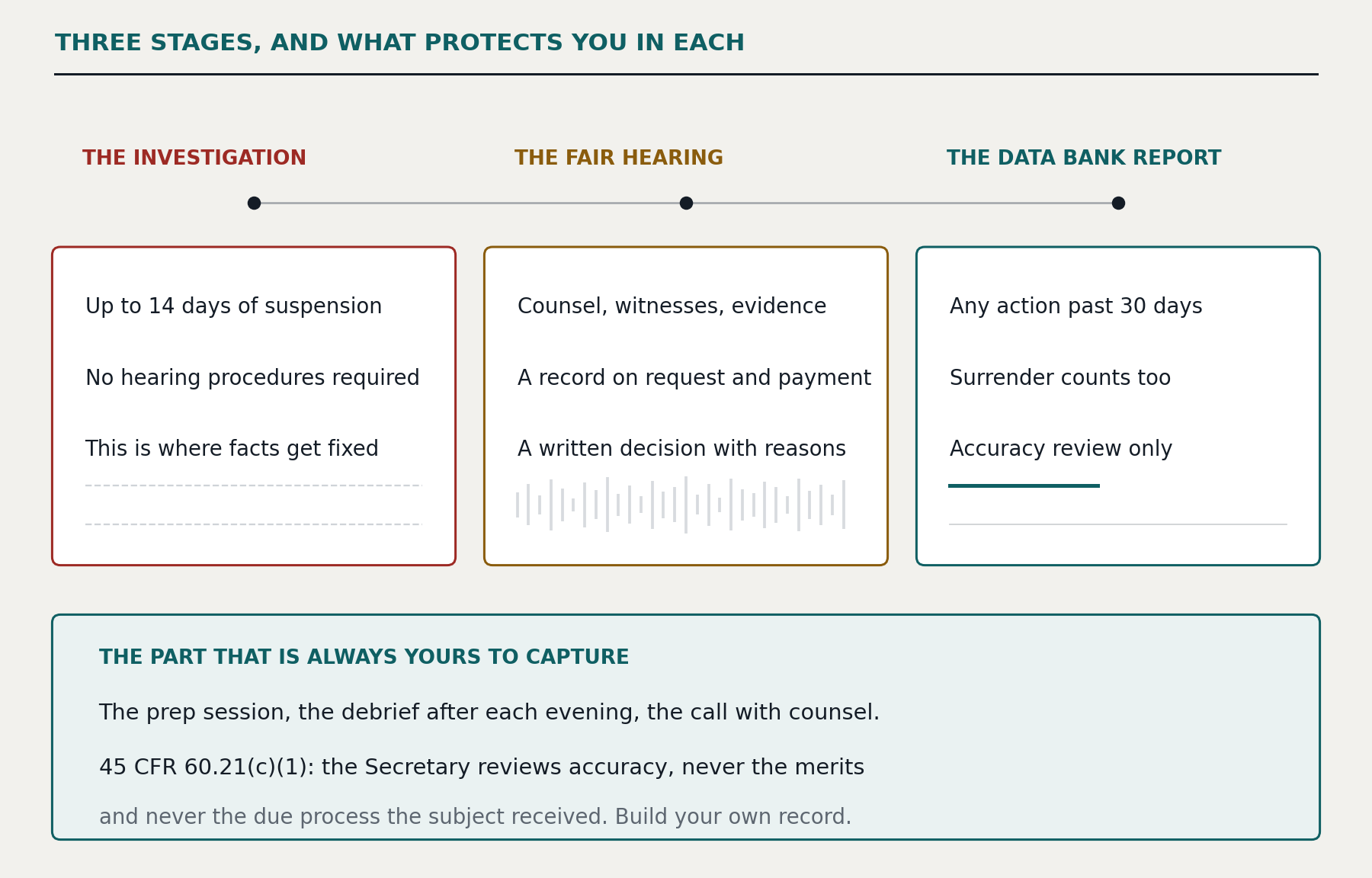
Section 11112(c)(1)(B) says nothing in the section requires those procedures for a suspension or restriction of clinical privileges for a period of not longer than 14 days, during which an investigation is being conducted to determine the need for a professional review action.
So the interviews that produce the file, with the nurses, the partners, and the physician, carry no statutory procedural floor. No counsel of right, no cross examination, no record.
By the time the fair hearing convenes, the account of what happened has already been assembled from those conversations and reduced to writing by the people conducting them. The hearing tests that account. It does not reconstruct it. Which means the interval where the facts are most fluid is also the interval where the statute asks the least of anybody.
Resigning to make it stop does not help. Under 45 CFR 60.12(a)(1)(ii), the hospital must report the acceptance of a surrendered or restricted privilege while the physician is under investigation, or in return for not conducting one. The exit that feels like containment is itself a reportable event, and it arrives at the Data Bank without the hearing that might have produced a record.
Why the Usual Workarounds Fail
- Assuming a court reporter is standard. Some bylaws require one; many make it a party’s option and a party’s expense. The bylaws control, and they are readable today.
- Leaning on the written decision. Section 11112(b)(3)(D) entitles the physician to a written recommendation and a written decision, each with a statement of its basis. Both are conclusions authored by the entity, not a record of the room.
- Notes taken by counsel. You cannot cross examine a department chair and transcribe that chair at the same time. Notes thin out exactly when testimony turns favorable.
- Planning to fix it at the Data Bank later. Under 45 CFR 60.21(c)(1) the Secretary will only review the accuracy of the reported information, and will not consider the merits or appropriateness of the action or the due process that the subject received. That review never looks at what happened in the room.
The last one deserves emphasis, because it is where most people assume there is a backstop. There is a dispute process, and it is real, but its scope is narrow by design. It asks whether the report accurately describes the action the entity took. It does not ask whether the action was fair, whether the hearing was adequate, or whether the chief of surgery said something on night two that the decision left out. A dispute filed on the theory that the hearing was unjust is answered on a question nobody asked.
What Actually Works
Read the medical staff bylaws and the fair hearing plan before there is a case, and find the clause on recording and on who pays. Then request the record in writing when the hearing notice arrives, not on the morning of the hearing.
Two things follow from putting the request in writing early. The first is practical: a court reporter has to be booked, and a request made the morning of night one is a request that cannot be honored. The second is evidentiary. A written request that went unanswered is itself a document, and it is a materially better position than a silence nobody can date.
Everything outside that hearing room is already yours. The prep session, the debrief after each evening, the investigative interview you sit in on: those are the highest value ten minutes in the matter. Nobody has to grant permission for you to keep an accurate account of a conversation you are a party to, and the debrief taken the same evening is worth more than a reconstruction attempted six weeks later, because memory does not degrade evenly. It degrades hardest on the specifics — which cases, which dates, whose approval — that decide these matters.
AmyNote captures them on the phone already on the table. Transcription runs on OpenAI’s latest Speech API, which handles the vocabulary that breaks consumer tools: focused professional practice evaluation, credentialing and privileging, summary suspension, morbidity and mortality conference.
Analysis runs on Anthropic’s Claude Opus, so you can ask the transcript what the chief of surgery said about the two approved transfers instead of scrubbing three hours of audio. Speaker identification separates counsel, client, and each panel member, with cross session memory carrying across an investigation running a year.
On privacy: both OpenAI and Anthropic contractually guarantee zero training on user data. Audio is encrypted in transit and not retained after processing. Transcripts stay local on the device with end to end encryption. No patient names and no peer review file sitting on a third party server.
Getting Started
Pull your medical staff bylaws and read the fair hearing article this week, not during a 30 day clock. Ask what a record costs and who orders it. Then record the debrief the same evening, while testimony is still exact, and draft from a transcript instead of memory.
The statute gives you a right to a record and then leaves it to you to exercise. The one part of this process nobody can decline to preserve is the part you were always free to preserve yourself. AmyNote runs on the phone already in your pocket.
Originally published as an X Article by @AmyNoteApp.