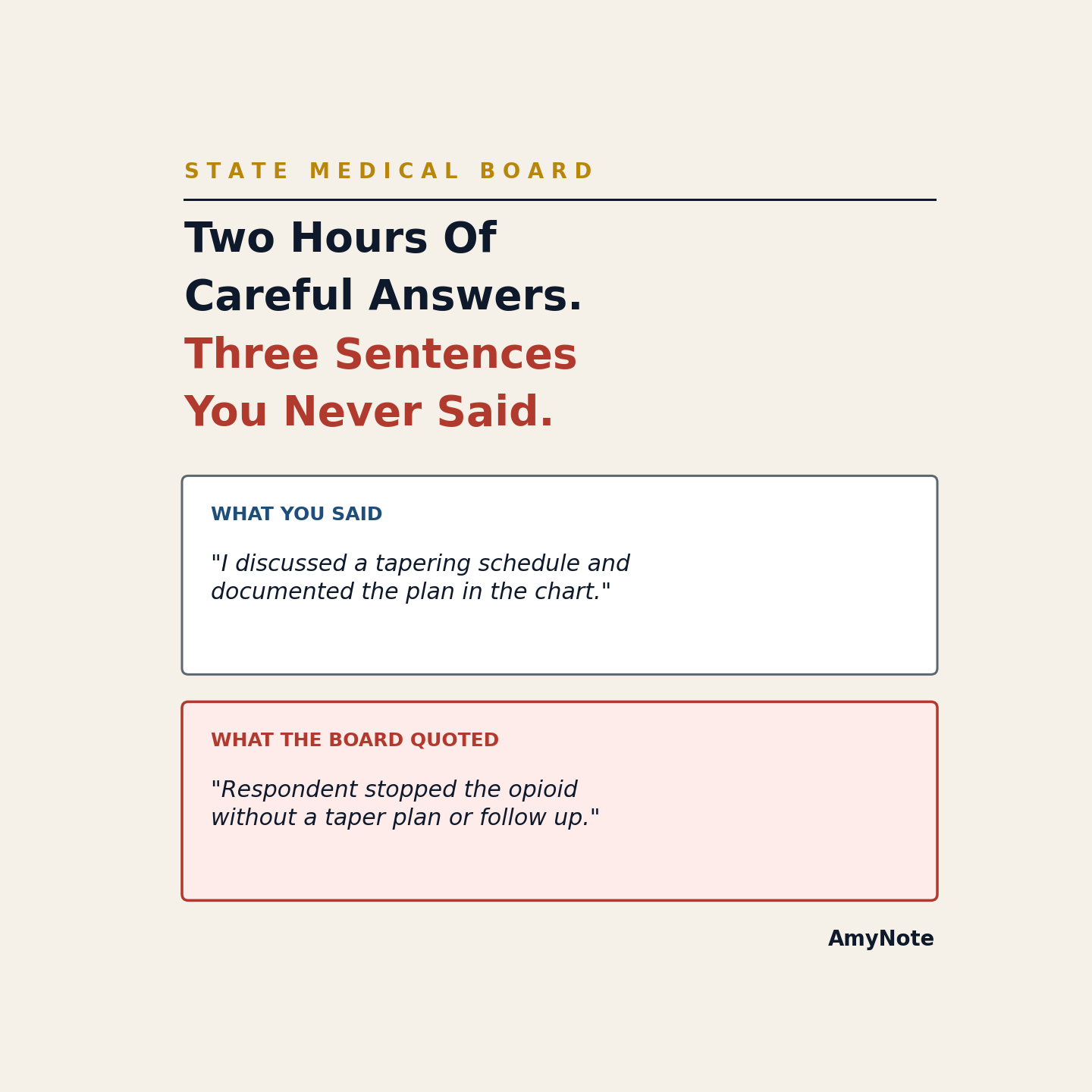
A state medical board investigator schedules a subject interview at your clinic on a Tuesday afternoon between patients. You answer every question carefully for two hours. You qualify every clinical judgment. You cite the note in the chart, the tapering plan, the call to the specialist. You walk the investigator through the timeline of the visit that triggered the complaint. Six months later a Statement of Charges arrives from the board prosecutor quoting you on sentences you flatly never said.
The Problem
A state medical board subject interview is the highest-stakes conversation in a physician's career. The complaint can come from a patient, a hospital peer review committee, an insurer flagging billing patterns, another physician, or an anonymous colleague. The investigator, often a former police detective or licensed nurse-investigator, arrives with a list of focused questions, a legal pad, and the complete authority to build the record that the board will read first.
Most states forbid the licensee from recording the interview unilaterally. Many investigators decline to record at all, citing investigative discretion. Requests to have a court reporter present are routinely denied. What ends up in the file is the investigator's contemporaneous handwritten or typed notes, later distilled into a Report of Investigation that the board prosecutor cites verbatim in the Statement of Charges.
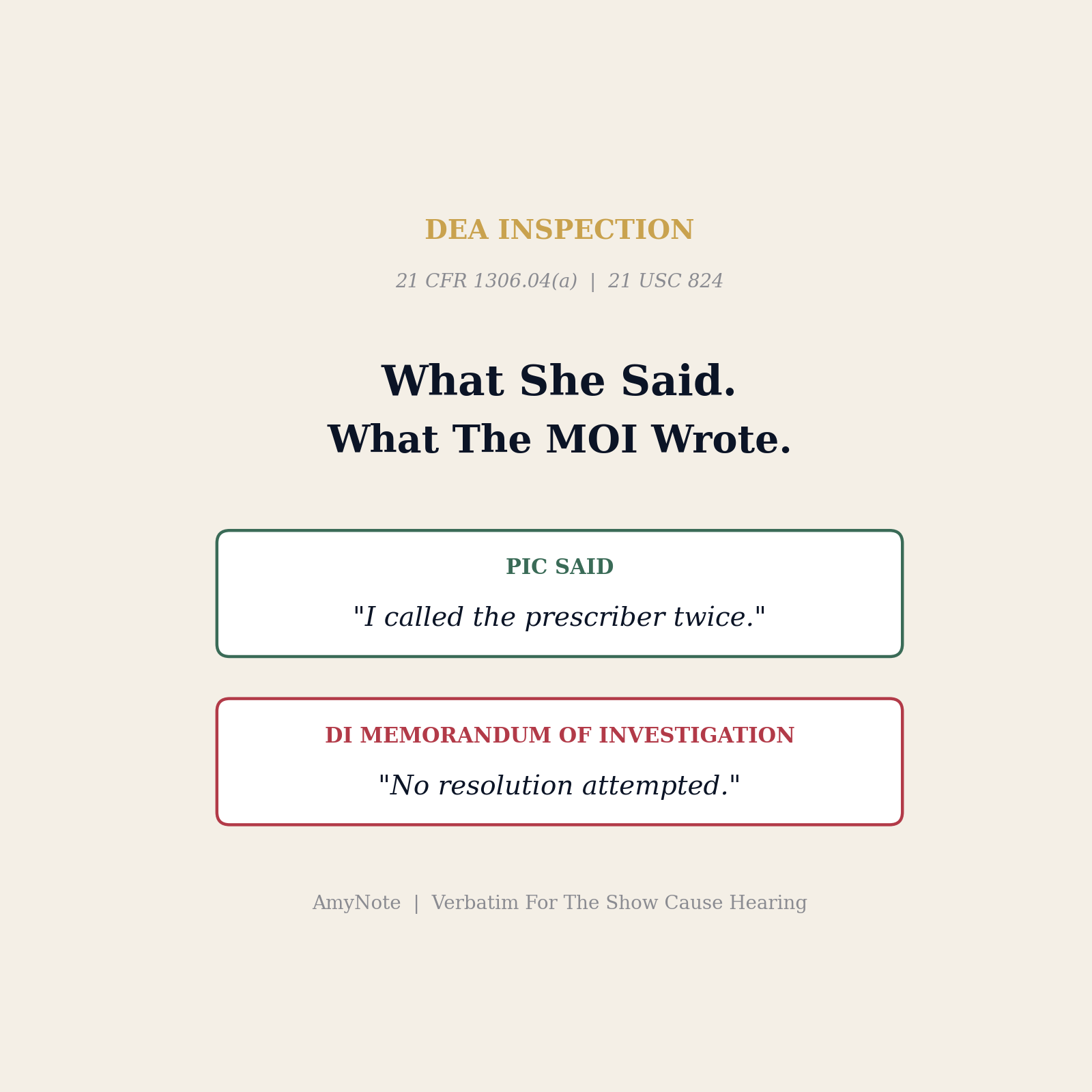
You walk out thinking the meeting went well. You answered honestly, qualified every clinical judgment, explained the standard of care. You never see the investigator's notes. The next written record you see is a charging document that compresses two hours of nuanced clinical reasoning into three damning sentences. "Respondent stated she discontinued the medication without a taper plan." "Respondent acknowledged failure to document informed consent." "Respondent could not articulate a differential diagnosis for the presenting complaint." Those sentences become the operative facts on which your license depends.
Why Current Solutions Fail
Defense counsel sitting beside you takes their own notes, but counsel is listening for legal exposure, not transcribing every clinical qualifier. A formal request to record is routinely denied or framed as non-cooperative. A reconstructed affidavit submitted weeks later carries no weight against the investigator's "real-time" notes, which the board treats as a quasi-transcript even when they are not verbatim.
Hospital risk management may attend, but they answer to the institution, not you — and when institutional interests and physician interests diverge, the risk manager's contemporaneous notes are not going to be filed in your defense. Court reporters cost $400 to $900 per session and require investigator consent that rarely comes. Personal notes taken during the interview are self-serving and impeachable at hearing. By the time you realize the charging document misquotes you, the only counter-evidence is your own memory against a sworn investigator's paper file.
The imbalance is structural. The investigator is trained to build a case-worthy record. You are trained to practice medicine. The tools each side brings to the conversation are not the same tools.
What A Formal Hearing Actually Turns On
A contested licensure hearing before an Administrative Law Judge or the board itself is not a jury trial. The board is presumed to bring institutional expertise; the physician bears the burden of producing evidence that rebuts the agency's contemporaneous record. "Respondent testified at hearing that she did discuss a tapering schedule" reads very differently from "Respondent produced a contemporaneous audio recording of the subject interview at which she explicitly stated: I discussed a tapering schedule with the patient and documented the plan in the chart on March 14."
Public interest and standard-of-care factors weigh heavily. A pattern of allegedly evasive answers in the Report of Investigation reads, to a hearing panel, as consciousness of guilt. A pattern of clear, timestamped, verbatim answers reads as the opposite. The same underlying interview gets characterized one way or the other based entirely on whether the physician has an independent record.
What Actually Works
The only fix is a contemporaneous, defensible, physician-controlled recording of the interview itself. Not a paraphrase. Not a counsel summary. The actual audio, with an accurate timestamped transcript you control.
AmyNote records the full subject interview on device, generates a speaker-labeled transcript using OpenAI's Speech API and Anthropic's Claude Opus for medical-terminology accuracy, and stores both audio and transcript locally on your phone or laptop. Drug names, procedure names, anatomical terms, and dosing schedules survive the transcription pass instead of being flattened into generic language. Both OpenAI and Anthropic contractually guarantee zero training on user data. Audio is encrypted in transit; processing copies may be retained to deliver and recover requested features. Transcripts are stored locally on the device with encrypted transport.
When the Statement of Charges quotes you as saying "I stopped the opioid without a taper plan," you open the timestamp, surface the verbatim line where you actually said "I discussed a tapering schedule with the patient and documented the plan in the chart on the March 14 visit," and your defense attorney files the exact transcript as exhibit one in the Answer to the Charges. The reconstruction problem disappears. The paper-file monopoly ends.
State Recording-Consent Law Matters
Roughly 38 states are one-party consent jurisdictions for in-person conversations, meaning any party to a conversation can lawfully record it without notifying the others. Eleven states require all-party consent. Your defense attorney advises on the specific rule for your state and any carve-outs that apply to investigative interviews.
In a one-party state, AmyNote running in your pocket during the interview is fully lawful and removes the verbatim gap before it forms. In an all-party state, the workflow is different: you disclose the recording, and if the investigator declines to consent, you document the refusal in writing and your attorney takes notes to the interview. Either way, the analysis starts with your defense attorney, not with the app.
The privacy posture matters as much as the recording itself. Subject-interview audio contains PHI, clinical judgment, and licensure-defense communication. The transcription pipeline must contractually not train on that audio. The audio must not be retained on third-party servers. The transcripts must be encrypted at rest on your device. Anything less invites a second front of regulatory exposure on top of the board investigation itself. AmyNote's stack is built for exactly this posture.
The Documentation Pattern That Holds Up At Hearing
A defensible physician workflow before a board investigation has four properties.
- The interview is captured contemporaneously. Not reconstructed from memory the evening after. Recorded on the physician's device in the room, in the moment, with the recording started before the first question and stopped after the last.
- The transcript is searchable by clinical term. Every mention of the drug, the dose, the diagnosis, the referral, the chart note is retrievable in seconds when the Statement of Charges lands months later. Reconstruction from memory is not the workflow. Retrieval from an indexed archive is.
- The recording lives under physician control. Not on the board's server, not on the hospital's server, not on a vendor's cloud storage where a subpoena can pull it without the physician's knowledge. Local storage on the physician's device with encrypted transport is the only posture that survives contested discovery cleanly.
- State recording law is checked first. One-party or all-party consent, plus any state-specific carve-outs for administrative investigations. Defense counsel signs off on the workflow before the interview date, not after.
Getting Started
Before your next board interview, install AmyNote on the device that will be in the room. Test it on a five-minute mock interview with your defense attorney. Confirm transcript accuracy on the clinical terms specific to your specialty — the drug names, procedure names, and anatomical vocabulary that a general-purpose transcription tool tends to flatten. Walk into the subject interview knowing that the official paper file is no longer the only record. Your verbatim transcript is.
The Statement of Charges will get written either way. The defense file is the difference between the verbatim and the paraphrase — and in licensure defense, that is often the difference between a favorable stipulation and a suspended license.
Originally published as an X Article.