The interview runs thirty-five minutes. You walk the examiner through the amendment, he pushes back on the obviousness combination, then says the words you came for: that limitation would probably get you past the secondary reference. Everyone hangs up.
Nothing was filed. Nothing was decided. What just happened exists only in the memory of three people, and one of them works for the government.
Then you sit down to write the summary and cannot remember whether he said the limitation overcomes the reference, or that it might, or that it does only if the specification supports it. Those are three different prosecutions, and the difference between them is a hedge you heard once, four days ago, while you were busy thinking about your next argument.
The Interview Is Not the Record
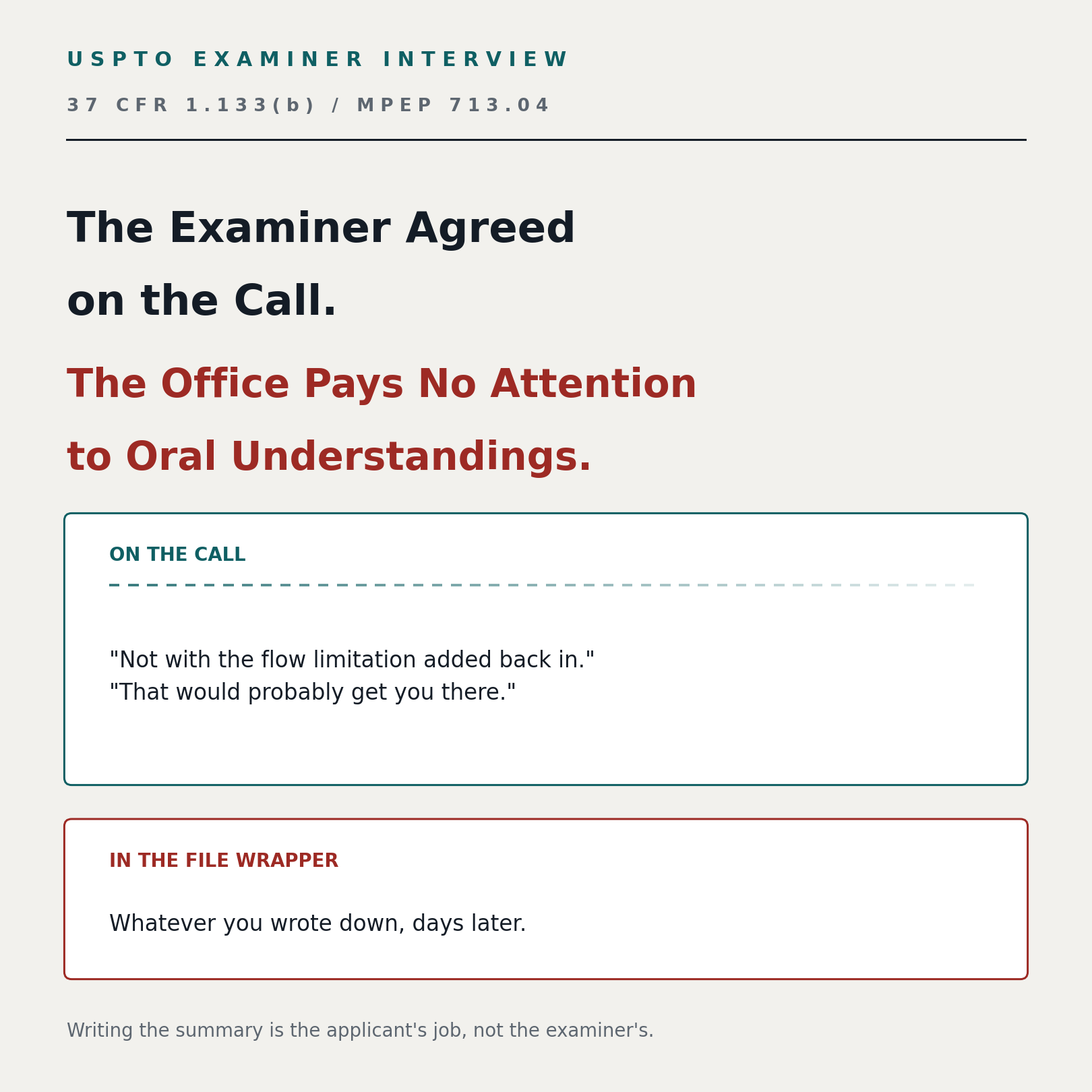
37 CFR 1.2 is blunt about where you stand. The action of the Office will be based exclusively on the written record, and no attention will be paid to any alleged oral promise, stipulation, or understanding in relation to which there is disagreement or doubt.
Read that second clause carefully, because it is doing more work than it appears to. It does not say oral understandings are given less weight. It says that where there is disagreement or doubt, they get none. The call is not the record. The summary of the call is the record.
Writing that summary is your job. Under 37 CFR 1.133(b), whenever reconsideration is requested in view of an interview, a complete written statement of the reasons presented at the interview must be filed by the applicant. MPEP 713.04 is direct on the point: for an applicant-initiated interview, it is the applicant’s responsibility to make the substance of record.
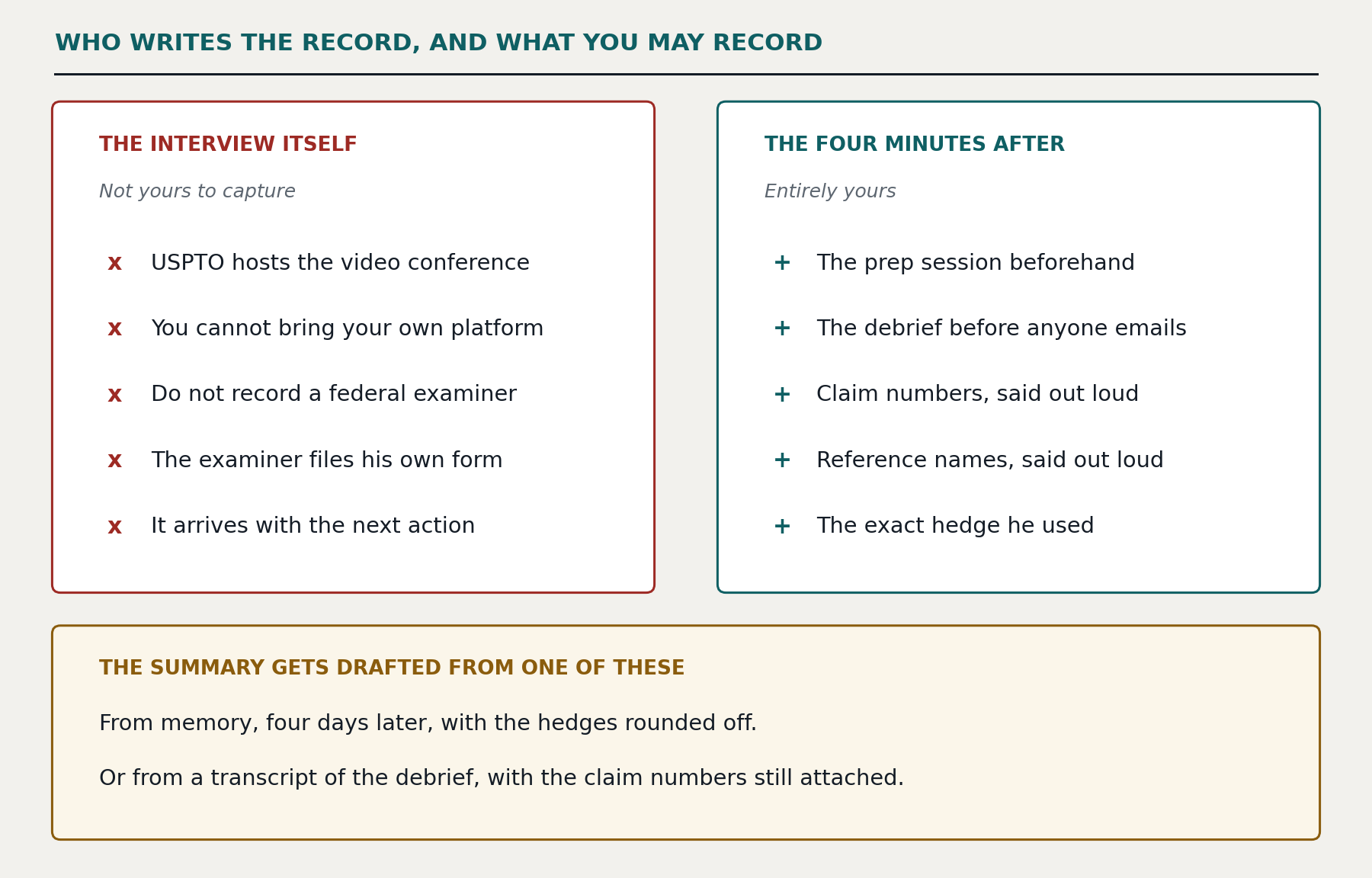
The examiner files his own Interview Summary form as well. It is typically brief and it is typically a checkbox. But when the two versions diverge, his is the one that got there first, and yours is the one that reads like a correction.
What the Summary Actually Has to Contain
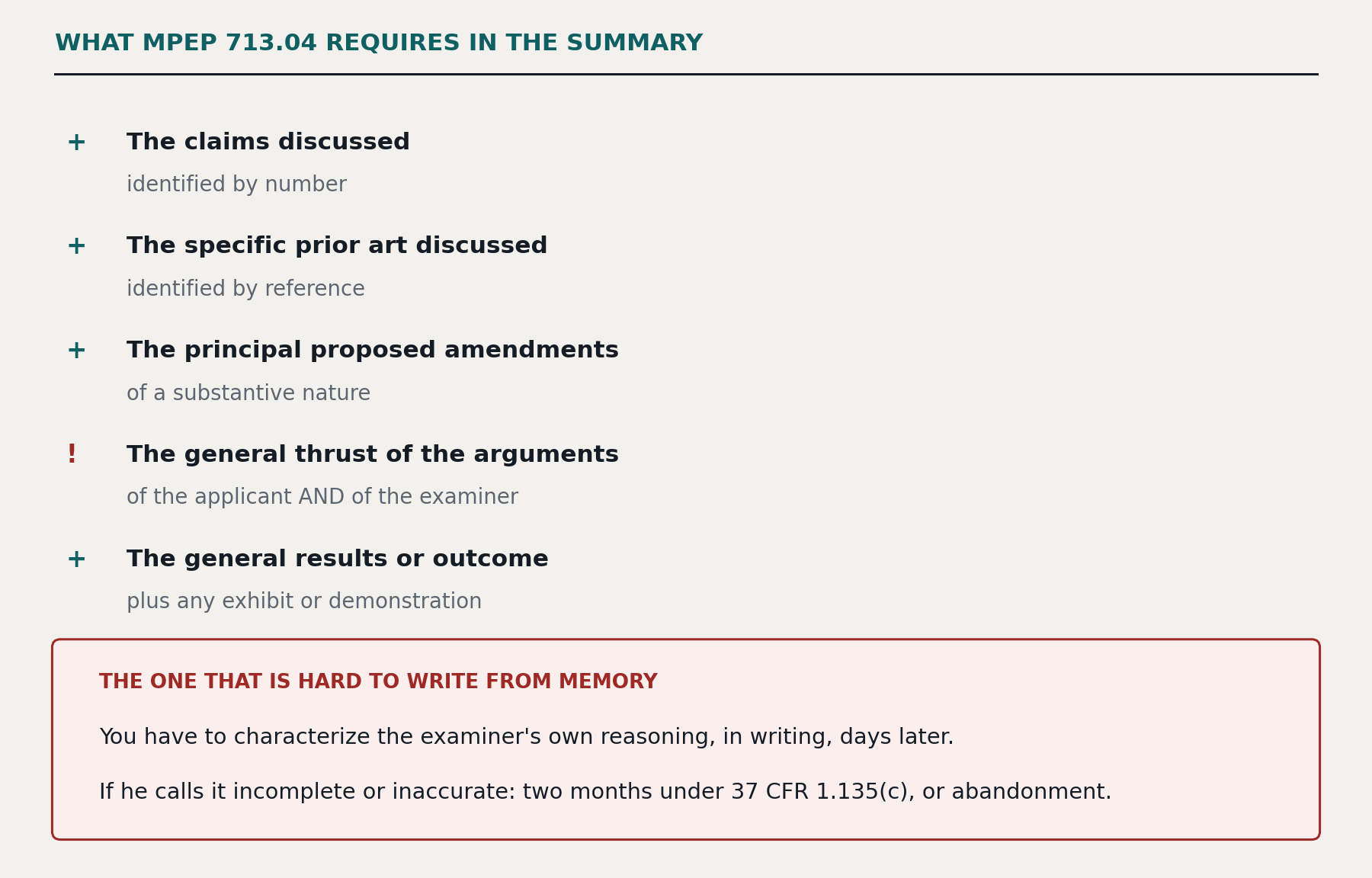
MPEP 713.04 will not accept “discussed claims 1 to 20, no agreement reached.” A complete and proper recordation has to include:
- The claims discussed, identified by number, and the specific prior art discussed, identified by reference.
- The principal proposed amendments of a substantive nature.
- The general thrust of the principal arguments of the applicant and of the examiner. Not verbatim, but enough that the argument is understandable from the file alone.
- The general results or outcome, plus any exhibit shown or demonstration conducted.
Read the third item again, because it is the one that breaks the standard workflow. You must characterize the examiner’s own arguments, in writing, from memory, days later — and do it accurately enough that a stranger reading the file wrapper can follow why the claim was allowed.
If the examiner finds your version incomplete or inaccurate, MPEP 713.04 lets him set a two-month period under 37 CFR 1.135(c) to supply the omission. Miss that period and the application goes abandoned. A memory lapse about a hedge becomes a docketing emergency, and then a revival petition.
Why the Standard Workflow Fails
Most prosecution teams rely on the same handful of tools. None of them survive contact with a fast technical argument.
- Handwritten notes. You cannot argue claim scope and transcribe at the same time. The notes thin out exactly when the discussion turns substantive, which is to say exactly when the record matters.
- The examiner’s form. It often arrives with the next Office action, weeks later, and it is a checkbox summary rather than a transcript. It is also written by the person whose reasoning you are supposed to be characterizing.
- Two recollections. An attorney and an associate on the same call routinely reconstruct different conditions attached to the same concession. Not because either is careless — because a conditional statement heard once, under pressure, compresses into an unconditional one in memory.
- Meeting bots. USPTO video conferences must originate from USPTO systems. You cannot bring your own platform into the call, and there is no version of this where recording a federal examiner is a good idea.
That last constraint is real and it is not negotiable. Do not record the interview itself. The fix is not a cleverer way around the rule. The fix is everything around the interview.
What Actually Works
The recoverable conversations are the ones you own. Record the prep session and the debrief, not the examiner.
Right after the call ends, before anyone opens email, the attorney and the associate talk for four minutes about what just happened. That is the highest-value four minutes in the entire prosecution, and almost nobody captures it. It is also the moment when the hedge is still intact, before it rounds itself off into something cleaner and less true.
Make that conversation deliberate. Say the claim numbers out loud. Say the reference names out loud. Say the exact words the examiner used, including the qualifier, and say who heard it that way. Four minutes of that produces a better summary than an hour of reconstruction on Thursday.
AmyNote records that debrief on the phone already sitting on the table. Transcription runs through OpenAI’s latest Speech API, which handles the vocabulary that breaks consumer tools: inherent anticipation, means-plus-function, written description support, reference names, claim numbers. Analysis runs on Anthropic’s Claude Opus, so you can ask the transcript a question instead of scrubbing an audio file — what did the examiner concede on claim 1, and what condition did he attach to it.
Speaker identification separates you from your associate with cross-session memory, so months later you know who characterized the concession and who questioned it. That distinction matters when the summary is challenged and the question becomes whose recollection the file actually reflects.
Semantic search spans every debrief in the file, which matters when the second interview lands months after the first and you need to know whether this examiner has moved on the same combination before.
On privacy: both OpenAI and Anthropic contractually guarantee zero training on user data. Audio is encrypted in transit and not retained after processing. Transcripts stay local on the device with end-to-end encryption. No client-confidential prosecution strategy sitting on a third-party server, which is the objection that ends most of these conversations before they start.
Getting Started
Start with the debrief. One recorded conversation, four minutes, right after your next interview. Draft the summary from a transcript instead of from memory, and then compare it against what you would have written on Thursday. The gap between those two documents is the thing this article is about.
Then look at what survives into the file wrapper. That wrapper is what a court reads fifteen years from now, during claim construction, when everyone who was on the call has moved firms and the only evidence of what the examiner agreed to is the paragraph you wrote from memory.
AmyNote runs on the phone already in your pocket. The trial at amynote.app runs three days with no limits and no credit card.
Originally published as an X Article by @AmyNoteApp.