You get a federal subpoena in the mail. Three weeks later you walk into a courthouse, swear an oath in front of twenty-three strangers, and answer questions from an Assistant U.S. Attorney for two hours. Your own lawyer waits in the hallway. You leave without a transcript, without a recording, and often without a clear memory of exactly what you said under oath.
The Problem
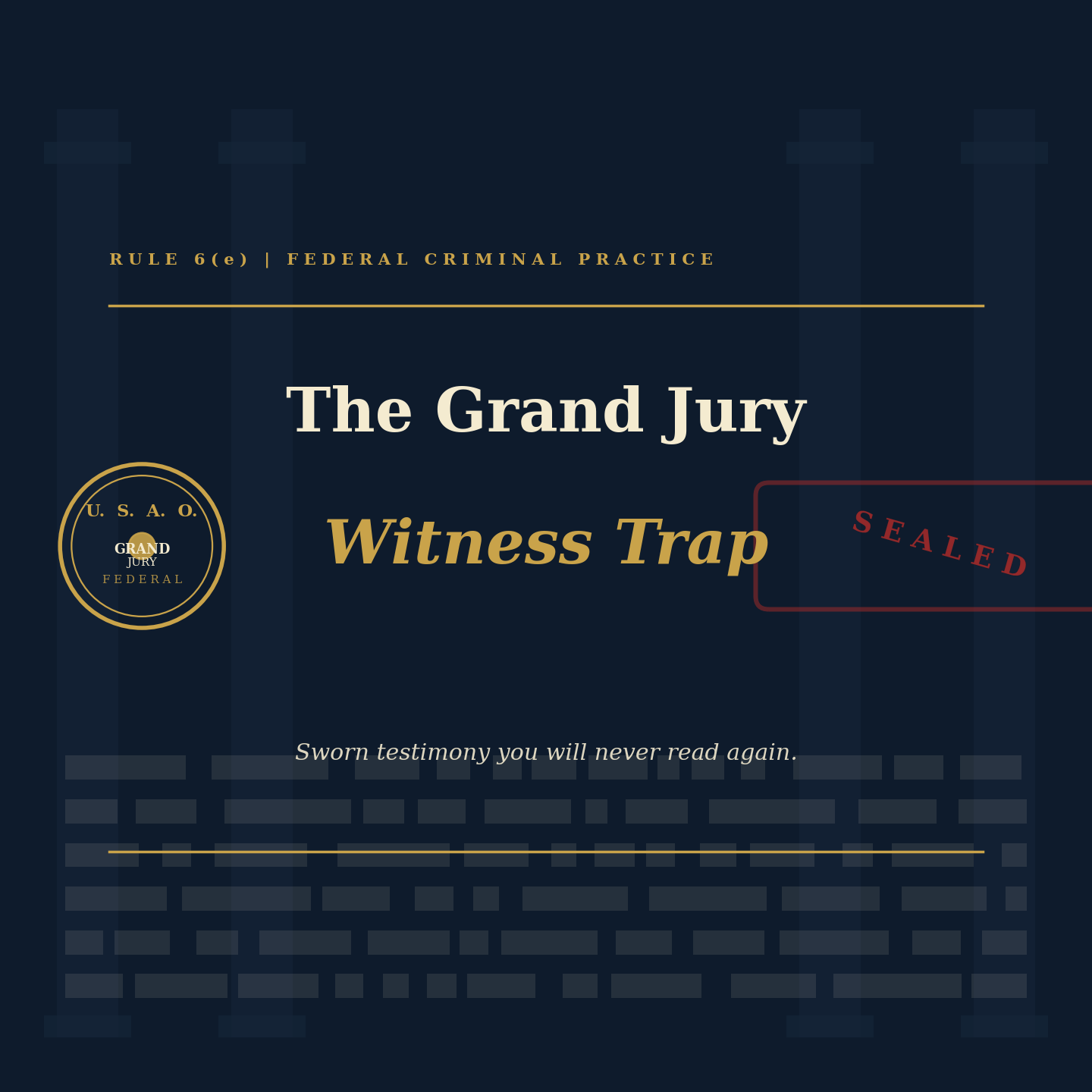
Federal Rule of Criminal Procedure 6(e) locks grand jury proceedings in secrecy. Grand jury witnesses cannot bring their own attorney into the room. They cannot record. They cannot obtain a transcript afterward. The court reporter's transcription belongs to the government, not to the witness.
If the grand jury returns an indictment months later, the transcript may surface at trial as prior sworn testimony. If a co-defendant flips, the transcript may become impeachment material against the witness. If prosecutors later decide the witness's answers were inconsistent with an FBI interview or a civil deposition, they may charge the witness with false declaration under 18 U.S.C. section 1623, a separate five-year felony that carries its own sentencing exposure.
The average federal grand jury investigation spans eighteen to twenty-four months. By the time testimony becomes a trial exhibit, the witness has testified about events they barely remember, in words they cannot reconstruct. Corporate custodians of records, cooperating employees, and target-adjacent witnesses face this gap most sharply. The only real defense is a contemporaneous account of what was asked and what was answered, written down within hours of stepping out of the grand jury room.
The Three Walls of Rule 6(e)
Three constraints define the room, and each one closes off a source of evidence the witness might otherwise rely on later.
No recording. Phones, watches, and recorders are surrendered at the door. The court reporter transcribes for the government. The witness has no equivalent copy.
No transcript. A grand jury witness has no right to a copy of their own sworn testimony. It surfaces months or years later, and often only when it is being used against someone, sometimes the witness.
No counsel inside. The witness's attorney waits in the hallway. The witness may step out to consult, but the AUSA controls the pace, the sequence of exhibits, and the framing of every question. Long pauses to consult look like evasiveness to jurors who cannot see the substance of the conversation outside.
Why Current Solutions Fail
The default advice from white collar defense counsel is come out and immediately debrief with me. Most people cannot do this well. You just testified for two hours under oath. You are exhausted, hungry, and your working memory of the exhibit sequence is already collapsing. Your lawyer is billing 1,400 dollars an hour to sit across from you while you struggle to reconstruct which Bates-stamped document was shown at which point, and which document referred to a topic your civil deposition also covered.
Handwritten notes on a legal pad are legible but slow and incomplete — you cannot write and remember what was asked at the same time. Voice memos on an iPhone capture your rambling recollection but bury the important admissions inside forty minutes of stream-of-consciousness. Nothing indexes what actually mattered, and nothing is searchable when your lawyer needs to compare grand jury testimony to your later FBI 302 six months from now, or to a civil deposition already in the record.
Eighteen Months of Silence
Between the day you testify and the day the transcript surfaces, the file goes quiet. The AUSA and grand jurors work. You wait. Eighteen to twenty-four months is the mean interval between initial witness appearance and superseding indictment in federal white collar matters. That is more than enough time for the human memory of a two-hour Q&A to become functionally unrecoverable.
When the transcript then arrives as a trial exhibit, it is presented as your prior sworn testimony. It has one owner in the courtroom — the government — and one reader who is expected to explain any inconsistency between it and every subsequent statement you made. That reader is you. The only document you control in that moment is the memorandum you dictated within an hour of leaving the grand jury suite.
What Actually Works
The technique that experienced Assistant U.S. Attorneys quietly respect: leave the grand jury suite, walk to a private conference room in the same building, and dictate a structured contemporaneous memorandum before speaking to anyone else, including a spouse.
AmyNote is built for exactly this workflow. You open the app, tap record, and describe what happened by section: the introductory background questions, every document exhibit shown to you and its Bates number, each substantive line of questioning, every moment you asked to step outside and consult with counsel, and any question you refused to answer on Fifth Amendment grounds.
Under the hood, AmyNote streams audio to your choice of transcription pipeline — either OpenAI Whisper or Anthropic Claude with real-time speech-to-text. Both OpenAI and Anthropic contractually guarantee zero training on user data. Audio is encrypted in transit; processing copies may be retained to deliver and recover requested features. Transcripts are stored locally on-device with encrypted transport, meaning the memorandum never touches an outside server after the transcription pass completes.
The transcript then feeds into a structured outline your defense counsel can read the same night, not next week. You segment it by question topic, exhibit number, and any moment privilege was invoked. Your lawyer walks into her next call with the U.S. Attorney's Office already knowing what needs a targeted proffer letter and what needs a Rule 17 subpoena of its own. That kind of preparation is the difference between a target letter and a declination.
The Consent Question
Recording inside the grand jury suite is prohibited. This is not about recording in the room. The memorandum is dictated after the witness leaves the suite, in a private space, describing from memory what happened. It is speech captured by the speaker, subject to one-party-consent recording rules that apply in federal court and most states. The point is not to smuggle a recording out. The point is to fix memory in a written record before it decays. The dictation is exactly the same technique defense counsel already uses to preserve their own recollections of witness meetings, applied by the witness on their own behalf.
Getting Started
Install AmyNote on your phone the day you receive the subpoena, not the morning of your appearance. Verify the microphone works in airplane mode. The moment you exit the grand jury suite, find a quiet room in the courthouse and dictate the full sequence of questions and answers while your memory is fresh. Then send the transcript to your counsel through her secure client portal.
It becomes the single most useful document in your defense file, and the one exhibit the government cannot see.
Originally published as an X Article by @AmyNoteApp.