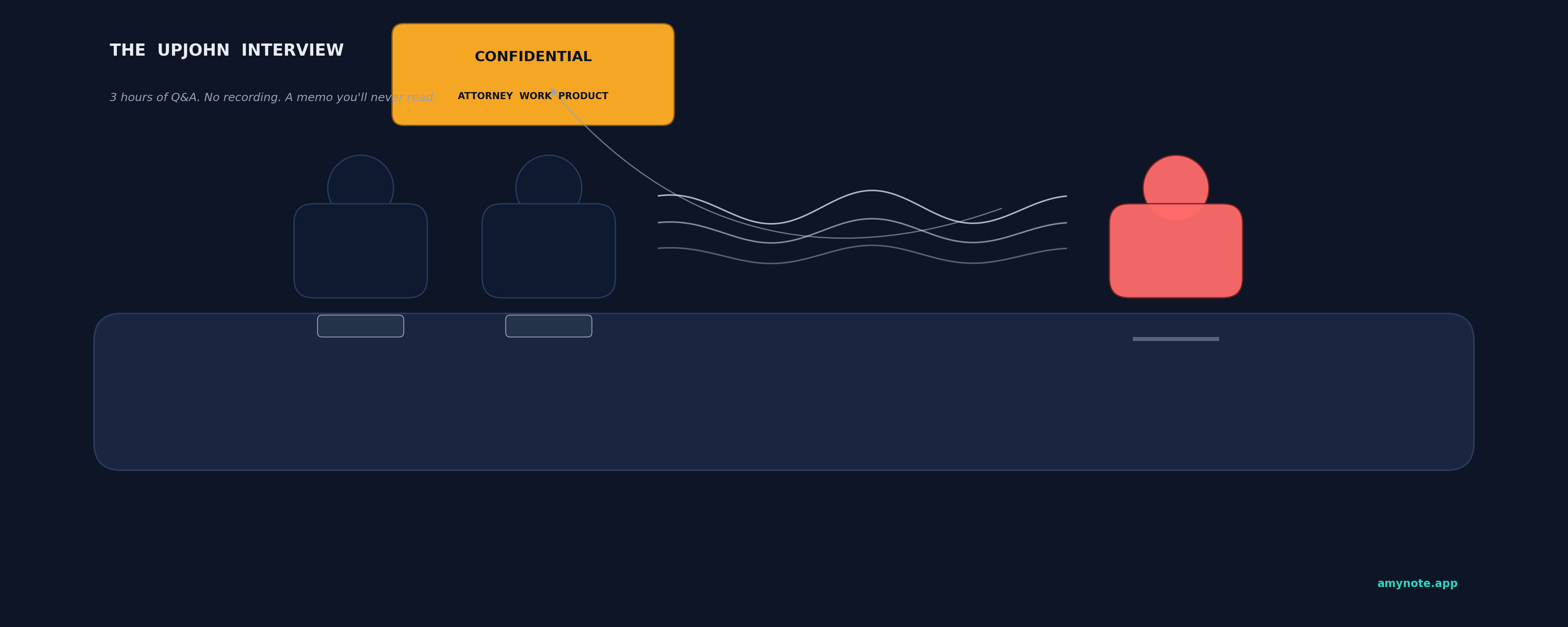
Outside counsel calls. HR sends a calendar invite that reads "Interview re: internal review." You show up in a conference room. Two lawyers you have never met open with an Upjohn warning — they represent the company, not you, and anything you say can be shared with the government. Then they ask questions for three hours.
Nobody hits record. Nobody keeps a transcript. A junior associate types notes on a laptop and drafts a memo the next week. That memo, along with dozens of others, becomes the factual backbone of a report that gets voluntarily disclosed to the DOJ or the SEC — and you never see it.
This is the reality of a modern corporate internal investigation. The interviewee — an engineer, a controller, a sales director, a VP of compliance — walks in with a fresh memory and walks out with nothing. Six months later, when the government reads back what "witnesses reported," the words are attributed to them, but the words are not theirs.
The Documentation Gap Nobody Talks About
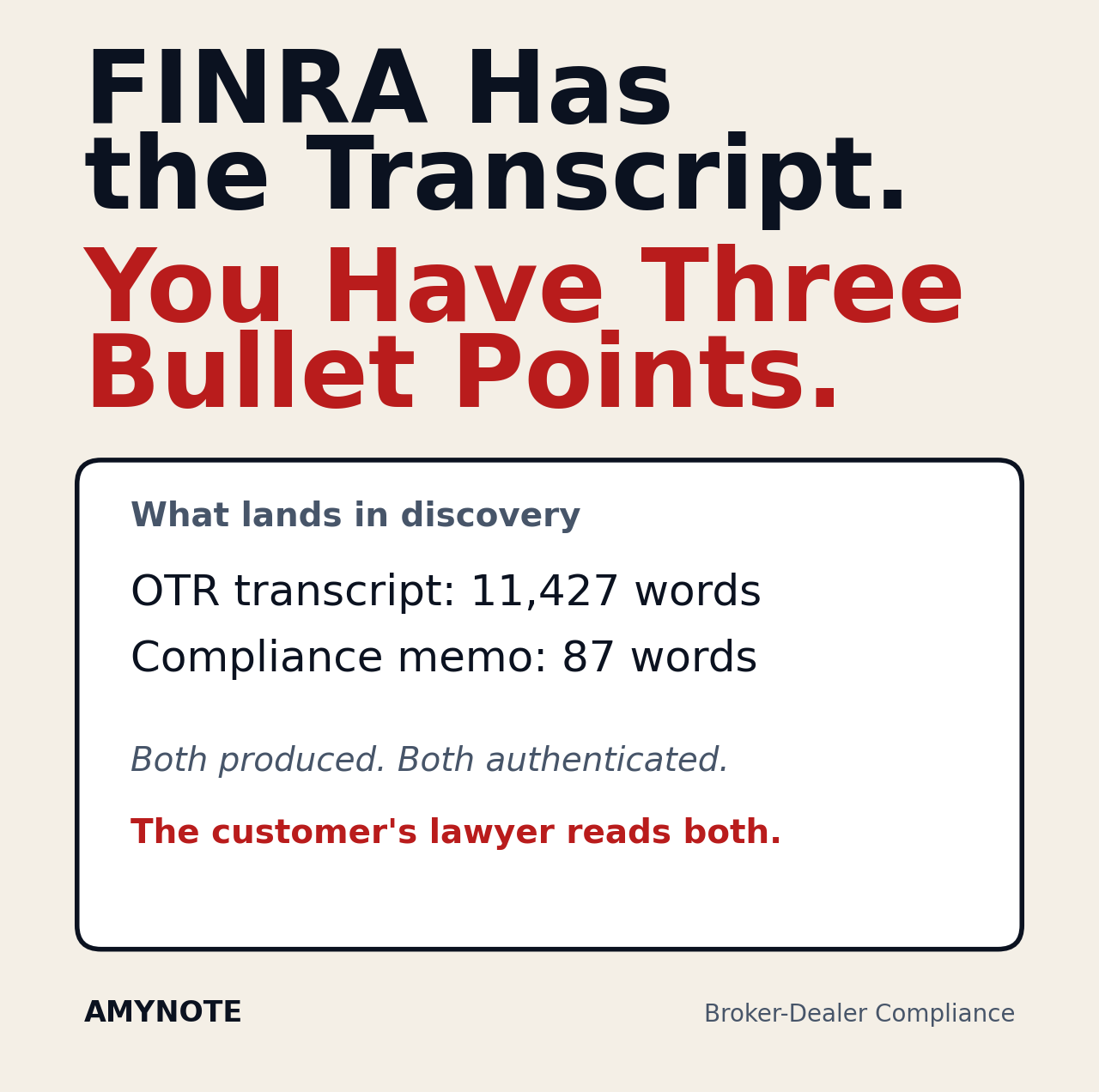
The interview memo is not neutral. It is attorney work product prepared for the company's defense. It selects, condenses, and paraphrases. It is written by the same lawyers who decide what gets flagged to the audit committee, what gets disclosed to regulators, and whose conduct becomes the story.
The witness has no independent record. No transcript. No recording. Often no notes — many firms tell interviewees not to take notes during the session. The witness has memory, and memory is exactly what a three-hour Q&A destroys. By the time the employee sits down at their desk that evening, half the sequence has already blurred: which topic came before which, which document was on the screen when the question about the Q3 pipeline was asked, which prior answer the interviewer was circling back to.
The stakes are personal. Under the DOJ's revised corporate enforcement policy and its individual accountability guidance, companies get cooperation credit only if they hand over facts about individuals. That means every Upjohn interview is a candidate exhibit in a case against the person in the chair. The company's memo may become the government's summary of what that person said, did, and knew.
Why "Just Ask For a Copy" Does Not Work
When employees ask for a copy of the memo, the answer is almost always no. The reasons are structural, not spiteful.
- Privilege belongs to the company. The memo is protected by attorney-client privilege and work-product doctrine — both held by the company, not the employee. Sharing the memo can waive privilege as to third parties.
- Selective waiver is a trap. Some companies later waive privilege in a targeted way to the DOJ or SEC. If they have shared the memo with the employee first, that argument gets weaker.
- The memo is a moving target. Interview memos get revised, cross-referenced, and merged into presentation decks and Wells submissions. There is no clean, final artifact to hand over.
- The interview is not the record — the memo is. In practice, the government treats the memo as what happened. The employee has no way to correct it after the fact.
None of this is aberrant lawyering. It is exactly how the doctrine is supposed to work — from the company's perspective. The employee's perspective is a different question entirely, and it is not one the company's outside counsel has been retained to address.
What Employees Actually Need
Employees who sit for an Upjohn interview do not need to change the company's process. They need their own record. Three things matter.
A verbatim transcript of what they actually said. Not a paraphrase. Not a summary. The exact wording, in order, with pauses and clarifications intact. Memory decays fast — within 48 hours the ability to reconstruct three hours of Q&A is essentially gone. Within a week the interviewee cannot reliably say whether they used the word "approved" or "acknowledged," and the difference between those two words can determine whether an individual charge is filed.
Contemporaneous notes tied to the transcript. Which document was on the screen when a question was asked. Which time period the questioner was drilling into. Which prior answer they were circling back to. This context is what allows personal counsel to spot leading questions or mistaken premises later.
A searchable archive across every interview session. Follow-up sessions are common. The government's picture of "what the witness said" is built by comparing statements across sessions. The witness needs the same ability, in reverse.
The Privacy Constraint
Any tool the employee uses has to meet the same standard as the memo itself — nothing on a third-party server that could be subpoenaed, nothing feeding an AI model that another party might later access, no cloud archive tied to a personal account that a corporate investigation could reach. The whole point is to hold a private record that only the employee and their personal counsel can see.
AmyNote records and processes locally. Audio is captured on the employee's own laptop or phone. Transcription runs through OpenAI's Speech API and AI analysis runs through Anthropic's Claude Opus. Both providers contractually guarantee no user data is used for model training and no audio is retained on their servers after processing. Transcripts and recordings are stored on the device with encrypted transport. AmyNote may retain cloud processing copies and results to deliver and recover requested features.
Personal counsel can be looped in cleanly. Separate outside counsel — the employee's own lawyer, not the company's — can review the transcript, flag misstatements, and prepare a supplemental submission if the company's memo turns out to distort what was said. Without a transcript, personal counsel is guessing. With one, personal counsel has the same raw material the company's associate had, minus the selective editing.
A Note on Consent
Recording law is state-specific. Federal law and most states allow one-party consent for recording a conversation, meaning the participant recording it does not need the other party's permission. A minority of states require all-party consent, and interviews that cross state lines can trigger the stricter rule. This is a question for the employee's own counsel — separate from company counsel — before the interview, not after. The point of a personal record is that it is legally captured, so the compliance step needs to happen up front.
What Effective Documentation Looks Like
An engineer summoned for an Upjohn interview about a revenue-recognition question walks in with a phone in her pocket recording locally. The three-hour session ends. Within minutes she has a time-stamped verbatim transcript, speaker-separated turns showing which lawyer asked what, and an AI-generated issue map of the topics that were pressed and the documents that were referenced.
Semantic search across the session lets her personal counsel run queries like "every time they asked about the Q3 pipeline call" and get every occurrence with surrounding context. Cross-session search lets that counsel compare the second interview to the first without asking the witness to re-remember.
Six weeks later, when the company's memo eventually surfaces in a related civil suit or a Wells notice, personal counsel can compare it side-by-side against what she actually said. That comparison is the difference between defending a real statement and defending someone else's paraphrase of it.
The Bottom Line
Upjohn interviews are structured to protect the company, not the witness. That is not a scandal — it is how the doctrine works. But it means the witness who walks in without their own record walks out at a permanent informational disadvantage. The lawyers on the other side of the table will remember the session through a memo. The witness deserves to remember it through a transcript.
AmyNote gives corporate employees and their personal counsel a private, on-device, verbatim record of every interview. Zero-training guarantees from OpenAI and Anthropic. All transcripts stored locally. Three-day free trial, no credit card. amynote.app
Originally published as an X Article.