A wildfire origin and cause investigator walks a five-acre burn scene with a witness who saw smoke first. The witness points at a treeline, gestures at the wind direction, names the neighbor who was burning slash at dawn. Two hours later the investigator sits in a truck cab and tries to type it all back into a report template.
The witness statement is worth more than any single photograph on that scene. And the process for capturing it is the same one that failed in the 1994 South Canyon fire and every subrogation trial since — a person with soot on their gloves trying to remember what the propane tech said about the regulator, forty minutes after the tech drove off.
The Burn Scene Problem
The NFPA 921 Guide for Fire and Explosion Investigations requires investigators to document witness statements, first responder accounts, and physical indicators in a defensible chain that supports the hypothesis of origin. In the field, both hands are occupied. One holds a scale ruler against a V pattern on a fence post. The other holds an evidence bag or a camera or a scene sketch on a clipboard that keeps trying to catch the wind.
There is no keyboard on the burn scene. There is soot, drip line water still running off structures, and a homeowner who is talkative right now but will not be reachable tomorrow. There is a first-in engine captain who has to leave in seven minutes to catch the next call. There is a public works foreman who mentioned a controlled burn permit and then remembered he was supposed to be somewhere else.
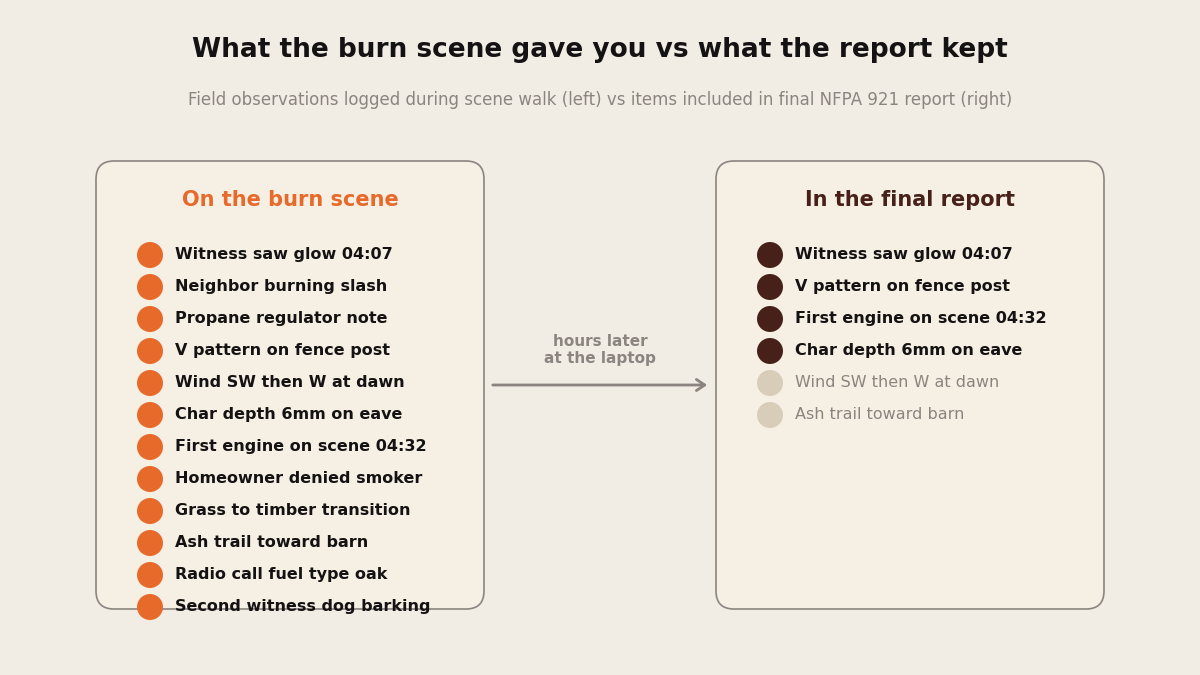
By the time the investigator is back at the truck, the sun has moved, the witness has gone home, and the propane technician who mentioned a regulator problem has driven off to his next call. Field notes exist as three sticky pages of arrows, angles, and half-words like prop W wind 04:07 saw glow. Everything else lives in the investigator's head.
Why NFPA 921 Cares About Timing, Not Just Content
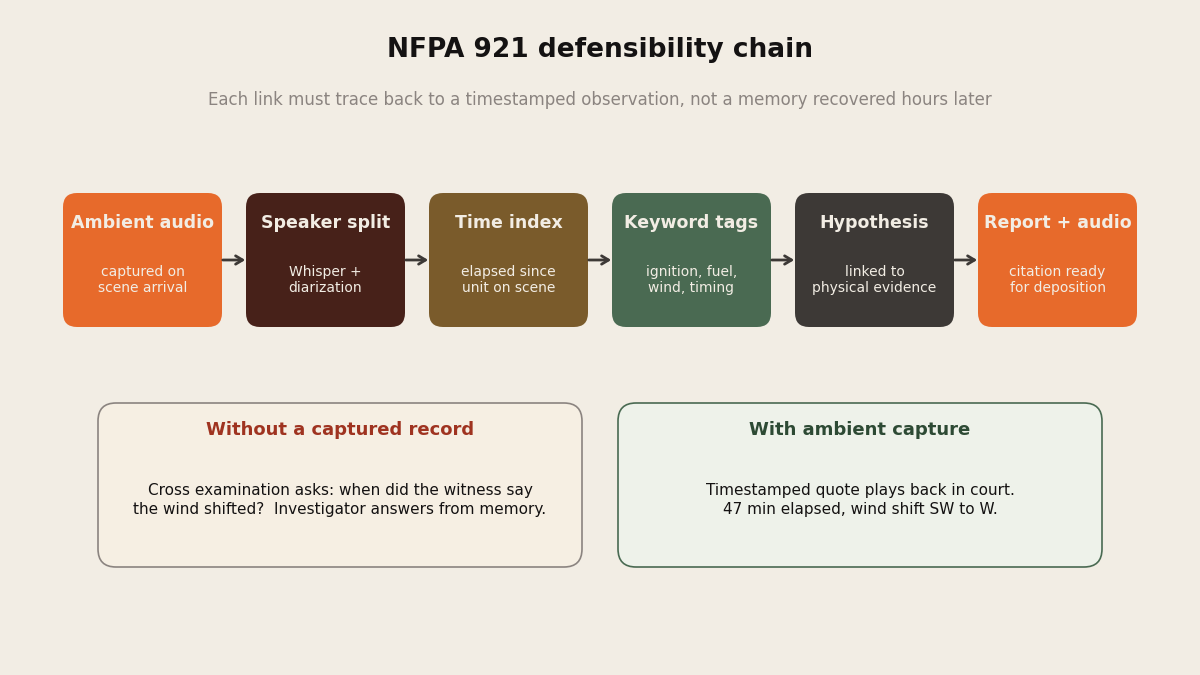
The 2021 edition of NFPA 921 is explicit that the investigator's hypothesis of origin must be traceable to the physical evidence and the witness statements, and that those statements must be captured in a manner that preserves the sequence in which observations were made. That last part is the one field workflows quietly break.
Timing matters because origin analysis is a sequence-of-events reconstruction, not a snapshot. A witness who says "I saw glow at 04:07 and heard a bang at 04:09" is describing a completely different fire than one who says "I saw glow and heard a bang, I think it was around four in the morning." The first statement, if defensibly captured, supports or defeats a specific ignition-sequence hypothesis. The second statement supports nothing except that something happened before daylight.
Cross-examination four years later at a subrogation trial will not ask what the witness said. It will ask when the witness said it, where the investigator was standing when they heard it, and what physical observation the statement was made in reference to. If the field notes cannot answer those three questions on the record, the origin opinion softens the moment it hits deposition.
Why Current Solutions Fail
Voice memos on a phone. Create a wall of unlabeled audio that has to be scrubbed later, one thumb drag at a time. There is no per-utterance timestamp, no speaker separation, no keyword index. A four-hour scene walk produces a four-hour file that nobody re-listens to in full.
Body-worn cameras. Record everything, including irrelevant conversation between investigators, small talk with the incident commander, radio traffic on adjacent incidents, and the tactical debrief in the parking lot. Every second becomes discoverable in subsequent civil litigation and subrogation actions. What was supposed to be documentation turns into a discovery liability the department's attorney did not sign off on.
Pen and paper. Fine until the wind takes the page or the drip line catches the notebook. Rite-in-the-Rain notebooks help, but gloved hands cannot write neatly, and the abbreviation that made sense at 08:22 does not always parse at 21:14 back at the office. Rewriting the note into the report the next morning is a memory reconstruction step the note itself was supposed to prevent.
Standalone dictaphones. Capture the words but strip the timing. NFPA 921 defensibility hinges on when a statement was made relative to physical observations, and a single unlabeled audio file cannot answer that. It also cannot answer who was speaking — the investigator's own narration and the witness's statement blur into one voice track that the subrogation defense will happily dissect on the stand.
Report templates opened in the truck cab. This is the failure mode that most reports end up in, precisely because the other options failed first. Typing from memory two to four hours after the observation, with no per-utterance anchor, is the mechanism that turns a defensible field call into an impeachable one.
What Actually Works
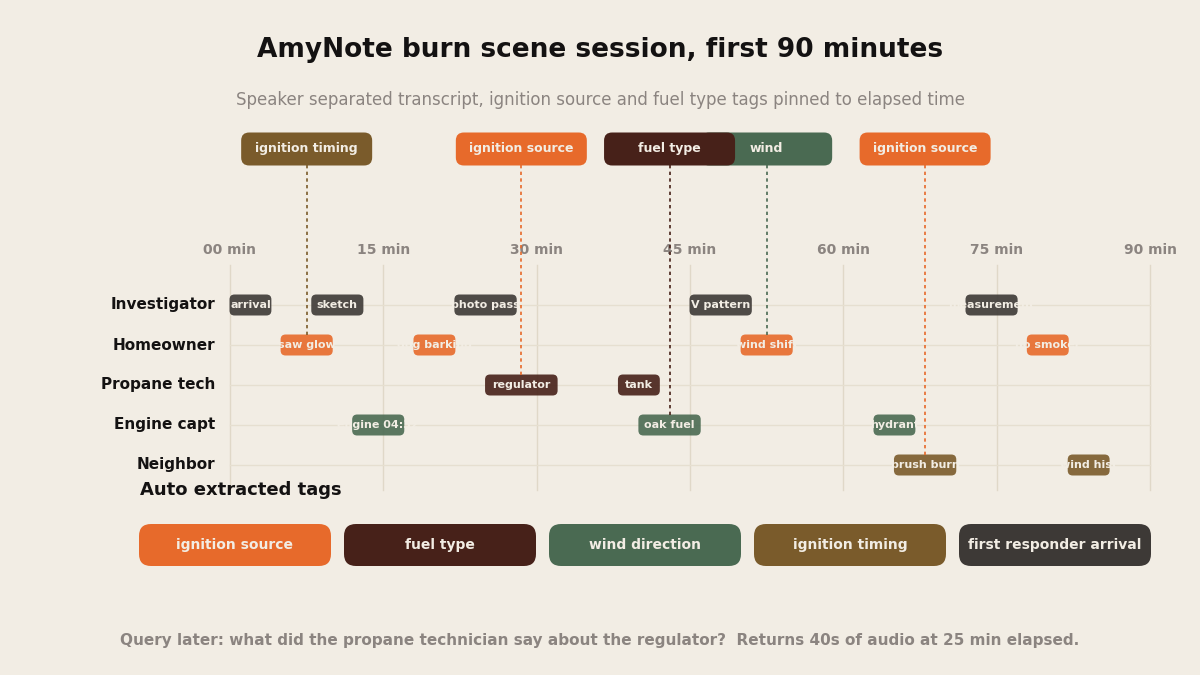
A field workflow that captures ambient audio continuously, timestamps every utterance against elapsed time from arrival on scene, and produces a searchable transcript indexed by witness name, burn indicator, and ignition source keyword. That is the pattern. Everything else is a variation on how to run it.
AmyNote uses OpenAI Whisper for transcription and Claude Sonnet for structured extraction, running a per-session pass that separates witness quotes from investigator narration, tags every mention of fuel type or ignition source, and pins a location marker to any spoken coordinate or landmark. Investigators can later query "what did the propane technician say about the regulator" and get back the exact 40 seconds of audio with the surrounding context and a timestamp.
- Speaker-separated transcript per session. Investigator narration is distinguished from witness statements, so the record shows who said what and when.
- Auto-extracted witness quotes tied to elapsed time. The subrogation defense cannot argue the statement drifted between the field and the report if the timestamp shows the statement was captured at minute 42 of scene arrival.
- Keyword index for fuel, ignition source, wind, and first responder arrival. Cross-examination discovery searches return the seconds of audio where the term appears, not the four-hour file where it might.
- Local storage. No cloud sync required for offline burn scenes with no cellular. The transcript lives on the phone, encrypted at rest, until the investigator is back at a desk.
Both OpenAI and Anthropic contractually guarantee zero training on user data. Audio is encrypted in transit; processing copies may be retained to deliver and recover requested features. Transcripts stored locally on device with encrypted transport. Nothing about a live wildfire investigation leaves the device without the investigator moving it.
The result is a witness interview record that survives cross-examination four years later when the subrogation case finally lands in front of a jury. The record shows the investigator standing at the north edge of the burn at 42 minutes past arrival, capturing a spoken statement from a named propane technician about a regulator observation. That is the artifact NFPA 921 wants and the artifact defense counsel cannot easily impeach.
The Documentation Pattern That Holds Up At Deposition
A defensible NFPA 921 witness interview record has four properties. The current workflow — note pads and truck-cab transcription — delivers zero of the four consistently. Structured field capture delivers all four.
- Contemporaneous. The statement is captured while the witness is speaking, not typed back from memory two hours later. The audio timestamp matches the moment the words were said, to the second.
- Speaker-attributed. The transcript labels the investigator's narration and the witness's statement as separate voice tracks. There is no ambiguity about who said what.
- Anchor-linked. Each statement is tied to the physical observation it was made in reference to. When the witness says "that treeline," the transcript has the surrounding narration that names which treeline.
- Searchable. Cross-examination discovery returns the specific 40 seconds where the propane technician talks about the regulator, not the four-hour file where those seconds might live.
Departments that adopt this pattern do not change the NFPA 921 methodology. They do not skip physical evidence collection or the origin matrix or any of the analytical steps that define a competent cause-and-origin investigation. They eliminate the specific class of transcription errors that turns a defensible field call into an impeachable one on the stand.
Getting Started
Install AmyNote before your next assignment. Bring it up in airplane mode if the burn scene has no cellular. Let it record ambient audio while you sketch and photograph. When you get back to the truck the transcript is already parsed, speakers separated, ignition-source mentions tagged. Your NFPA 921 report writes itself from field observations you actually made, not the ones you tried to remember.
The subrogation defense does not care whether your notes were neat. It cares whether your record supports the sequence-of-events hypothesis you signed. Structured field capture, produced at the burn edge and delivered to the report template pre-sorted by speaker and keyword, is the shortest path between the two.
Originally published as an X Article.